


The new Docket Reports are free through the end of 2017. This extended preview period allows plenty of time to evaluate before deciding whether to budget for a subscription. It also allows us time to receive feedback and make changes, if necessary, before we begin charging for the service in 2018. Of course, there is no obligation to subscribe after the free preview, and there will be no "surprise" auto-billing of any kind.
To receive any of the new Docket Reports, please click here.
"Does 35 U.S.C. § 318(a), which provides that the Patent Trial and Appeal Board in an inter partes review 'shall issue a final written decision with respect to the patentability of any patent claim challenged by the petitioner,' require that Board to issue a final written decision as to every claim challenged by the petitioner, or does it allow that Board to issue a final written decision with respect to the patentability of only some of the patent claims challenged by the petitioner, as the Federal Circuit held?"With Docket Navigator's Motion Success charts, you can create statistics in real-time, 24/7 that show the number of petitions for IPR that had all challenged claims granted, all challenged claims denied, and some claims granted or denied. In the following Motion Sucess chart, the red portions of the chart are petitions that had all challenged claims denied IPR, the green portion had all claims granted, and the gray "partial" portions had some claims granted, and some claims denied IPR:

Success Rates of PTAB Institutions of IPR
As a percentage of total decisions, partial institutions have decreased each year since the AIA was enacted. Denials of all challenged claims (the red portions of the chart) are at an all-time high as a percentage of total institution decisions for each year.


The judges chart has been updated to reflect the actual number of cases per judge, rather than their percentage of the overall cases. Please note that district judges and magistrate judges are many times on the same cases, so there will be an overlap of those judges' cases. Therefore, the total number of cases will not equal the sum of each individual judge's cases.


Once a motion to challenge a patent’s validity through an IPR or PGR process is filed, the administrative judges at the PTAB decide whether to institute the review. If institution of the IPR or PGR is denied, then the legal matter is closed and the interested party filing for PTAB review must find another way to challenge the patent’s validity.
The rate of institution for IPRs and PGRs filed against patents in the pharmaceutical and biotech sectors is on the rise recently, according to statistics pulled from Docket Navigator’s data analytics services. Of the 231 combined IPR and PGR petitions filed against such patents during 2015, a total of 92, or 39.8 percent, were denied institution by the PTAB. Thus far in 2016, the PTAB has denied institution on only 34.3 percent of the 254 IPRs and PGRs filed this year against drug and biotech patents. This means that the percentage of review processes which are granted either in full or in part by the PTAB is increasing.

Meanwhile, institution denial rates for all other patent classifications has remained very steady over nearly two years. Through most of 2016, the rate at which IPR and PGR petitions on other patents are denied institution by the PTAB is 33.2 percent. This is very close to the same percentage of such petitions being denied institution in 2015, when 450 petitions of a total 1,349 IPR and PGR petitions were denied institution by the PTAB. It bears noting that the percentage of IPRs and PGRs which are granted institution has risen from 37.6 percent in 2015 up to 42.3 percent thus far through 2016, which means that the percentage of petitions which are only partially granted has dropped from 29 percent in 2015 down to 24.3 through most of 2016.

Overall, 2016 looks like it will see fewer IPR and PGR instituted decisions at the PTAB than last year. By the end of 2016, it’s estimated that a total of 1,266 IPR and PGR institution decisions will be filed, lower than the 1,349 such decisions filed through 2015. So while the percentage of petitions granted full institution by the PTAB is up in 2016, the total amount of institutions is down.
If the current trend continues, 2016 may be the first year where the number of petitions filed in the PTAB decreases from the previous year. Docket Navigator estimates that there will be 1,716 total petitions (IPR, PGR, and Covered Business Method Reviews) filed in 2016, compared with 1,798 that were filed in 2015.

Accurate data analytics can give both patent owners and legal teams a better idea of the challenges which are unique to a certain sector of technology. Docket Navigator delivers such analytics which can be helpful to those who need help navigating patent challenges at PTAB.
One of the rule changes affecting PTAB proceedings allows patent owners an opportunity to supply new evidence with their preliminary response to the petition before the PTAB decides to institute patent review proceedings. Public comments received by the USPTO argued that the new rule would help level the playing field in PTAB proceedings, allowing evidence from both sides prior to the decision to institute an IPR or other proceedings. The preliminary response is a voluntary action for a patent owner and the USPTO maintains that “no negative inference will be drawn” if a patent owner decides not to file a preliminary response.
Since these rules went into effect on May 2nd, patent owners have had this new option for responding to patent challenges at the PTAB. Now, Docket Navigator has made search tools available for those who want to find out whether a preliminary response containing new testimony provides any benefit to a patent owner.
Of the 16 institution decisions filed since May 2nd in IPRs in which a patent owner filed a preliminary response with a declaration, seven IPRs were granted institution while six others were denied; the remaining three were granted partial institution. This is admittedly a small sample size, so caution should be used when extrapolating statistics from it. As Rick Neifeld, of Neifeld IP Law in Alexandria, VA, commented, “We should have a statistically significant number of cases by the end of September.” When compared to the overall success rate of IPR institution decisions filed during that same time period, the results so far seem to indicate that IPRs are denied more often when a patent owner files a preliminary response. Of the 380 institution decisions in IPRs filed between May 2nd and August 26th of this year, 122 have been denied institution while 172 have been instituted.


Taking out the IPR petitions in which a preliminary response has been filed without a declaration, it’s easy to see that the filing of a declaration with the preliminary response at least correlates with higher rates of denial of institution for IPRs. Of 364 IPRs in which the patent owner did not file a declaration with the preliminary response, just under 32% were denied institution while more than 45% were granted institution. When preliminary responses with declarations are filed by a patent owner (see the first chart), IPRs are denied institutions at a rate of 37.5%. Partial institutions also rise slightly when declarations are filed with preliminary responses to about 19% percent compared to around 23% when declarations aren’t filed with the preliminary responses.

The American intellectual property landscape continues to shift and it is helpful for patent owners to stay on top of how recent legal developments can affect their ability to retain their patent rights. With Docket Navigator, a patent owner has sophisticated tools which can provide insights into the best methods for defending against a PTAB challenge.
A plaintiff’s choice of venue in patent infringement cases is defined by Section 1400(b) of U.S. Code Title 28, which states that civil actions for patent infringement may be brought in the judicial district where the defendant resides or where the defendant has committed infringement and has a regular and established place of business. Because patent infringement plaintiffs can bring action in a venue where the defendant is doing business and not where it is headquartered, both the cost and inconvenience of defending a case in a distant venue may be reason enough for file a motion for a transfer of venue.
Legal teams preparing a defense for a party in a patent infringement suit filed in E.D. Tex. might find effective strategies for arguing a transfer of venue by investigating what has worked for others in the past. It’s not that rare to find cases in E.D. Tex. which have seen a motion to transfer venue granted.

As of this writing, in 2016 alone, there have been nearly 50 patent infringement cases which have been transferred out of E.D. Tex., with 19 of those cases ending up in the U.S. District Court for the Northern District of California (N.D. Cal.).

One such case which was successfully transferred is Game and Technology Co. Ltd. vs. Blizzard Entertainment, Inc. et al. Game and Technology Co. brought suit against Blizzard and others, including Valve Corporation and RIOT Games, in E.D. Tex. over a trio of patents related to video gaming and online gameplay. The court granted the motion to transfer venue based on the fact that the relevant evidence and witnesses were more easily found in the districts identified by the defendants. Blizzard does business in the area covered by E.D. Tex. but the primary function of that office was customer support. The cases involving Blizzard and RIOT were directed to the U.S. District Court for the Central District of California (C.D. Cal.), while Valve’s case was transferred to the U.S. District Court for the Western District of Washington (W.D. Wash.).
Another E.D. Tex. case in which the defense’s motion to transfer venue was successful is Intelligent Automation Design, LLC vs. Zimmer Biomet Holdings, Inc. et al. The patent-in-suit protects a method of controlling how screws are seated to prevent them from becoming stripped. Biomet Microfixation, one of the case’s defendants, petitioned for a transfer of venue based upon the fact that a previous case involving a Zimmer company was transferred out of E.D. Tex. for convenience. Biomet Microfixation also noted that it has no offices or facilities in Texas as well as the fact that the accused system was developed in the Kansas City region. The case was transferred to the U.S. District Court for the Middle District of Florida (M.D. Fla.), which is where Biomet Microfixation’s headquarters are located.
There are dozens of recent patent infringement cases which legal teams can analyze to determine successful strategies for motions to transfer venue. Docket Navigator gives attorneys the analytical tools they need to quickly find granted motions regardless of the district court within which the case was originally filed.
On July 1st, Judge Alsup issued a notice regarding opportunities for young attorneys in a case which he is trying. The case is Illumina, Inc. et. al. v. Qiagen, N.V. et. al., case number 16-CV-2788. The case revolves around a patent held by Illumina in the field of DNA sequencing, U.S. Patent No. 7566537, entitled Labelled Nucleotides. At issue is Qiagen’s marketing of a DNA sequencing product known as GeneReader which Qiagen has attempted to market in areas under the jurisdiction of N.D. Cal., including San Francisco and Pleasanton.
Judge Alsup is specifically seeking young attorneys with four or fewer years of experience out of law school to argue two motions filed by the defense. One is a motion to transfer the case to the District of Delaware (D. Del.), where Qiagen argues that the parties have already been litigating the validity of the ‘537 patent. The other is a motion to dismiss the case because of a lack of personal jurisdiction. Both motions were filed around the middle of June.
The insight afforded by the legal case analytics services offered by Docket Navigator can keep a firm informed on a judge’s past decisions in the face of various motions. In this particular case, it could help the young attorneys involved with the Illumina v. Qiagen case make an educated decision on the likelihood that Judge Alsup would decide in favor of either of these motions.
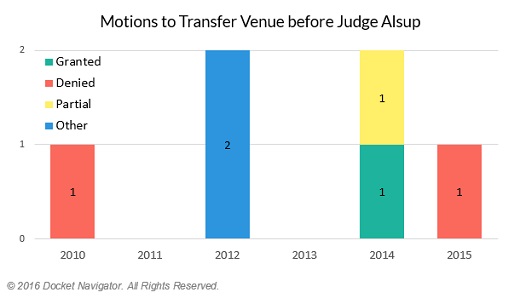
On the motion to transfer to a new venue, Docket Navigator analytics show that, historically, Judge Alsup has split down the middle in terms of granting or denying such a motion. One 2010 motion to transfer was denied because Judge Alsup was not convinced that the transfer would be convenient to both parties. On the other hand, Judge Alsup granted a 2014 motion to stay or transfer a case in light of actions pending in related cases in the Eastern District of Texas (E.D. Tex.). Overall, in six motions to transfer, Judge Alsup has denied two motions, granted one, granted another in part and two others either had their ruling deferred or additional briefing was requested.
Motions to dismiss due to a lack of personal jurisdiction are a much tougher sell to Judge Alsup. Since 2010, he has denied four such motions while only granting two; another motion to dismiss had its ruling deferred. In 2015, a motion to dismiss filed by an individual defendant who alleged he never personally managed any of the activities related to the infringement within the jurisdiction of N.D. Cal. was denied because Alsup decided that the defendant was subject to a forum-selection clause of a sales-agency agreement. On the other hand, Judge Alsup granted a 2012 motion to dismiss for lack of personal jurisdiction after a related case being argued in D. Del. reached the same conclusion.

Data analytics can be crucial to legal teams, especially those trying to get positive results for their younger, inexperienced associates. Docket Navigator provides tools which help legal teams prepare for a wide range of legal motions.
This guest post was written by Steve Brachmann.
Under the new law, called the Defend Trade Secrets Act of 2016 (DTSA) a trade secret owner may file a civil action in a U.S. district court seeking relief for trade secret misappropriation related to a product or service in interstate or foreign commerce. The bill establishes remedies including injunctive relief, compensatory damages, and attorney's fees, and sets a three-year statute of limitation from the date of discovery of the misappropriation.
As of this writing, new DTSA claims have been filed in at least 15 federal cases. Docket Navigator is expanding its coverage to include several new practice areas, including DTSA. Unfortunately, PACER’s case classification categories do not yet include DTSA claims, so identifying cases asserting those claims presents a challenge. The process will be significantly improved once PACER creates a Nature of Suit flag for DTSA cases.
As we discover additional DTSA cases, they will be added to the list in real time. Docket Navigator subscribers can create an alert on the link above to be notified of new DTSA cases. In addition, subscribers may click on an individual case to be notified when new documents are filed in that case.
If you are aware of a DTSA case that does not appear in the list above, please contact us with the information.


